
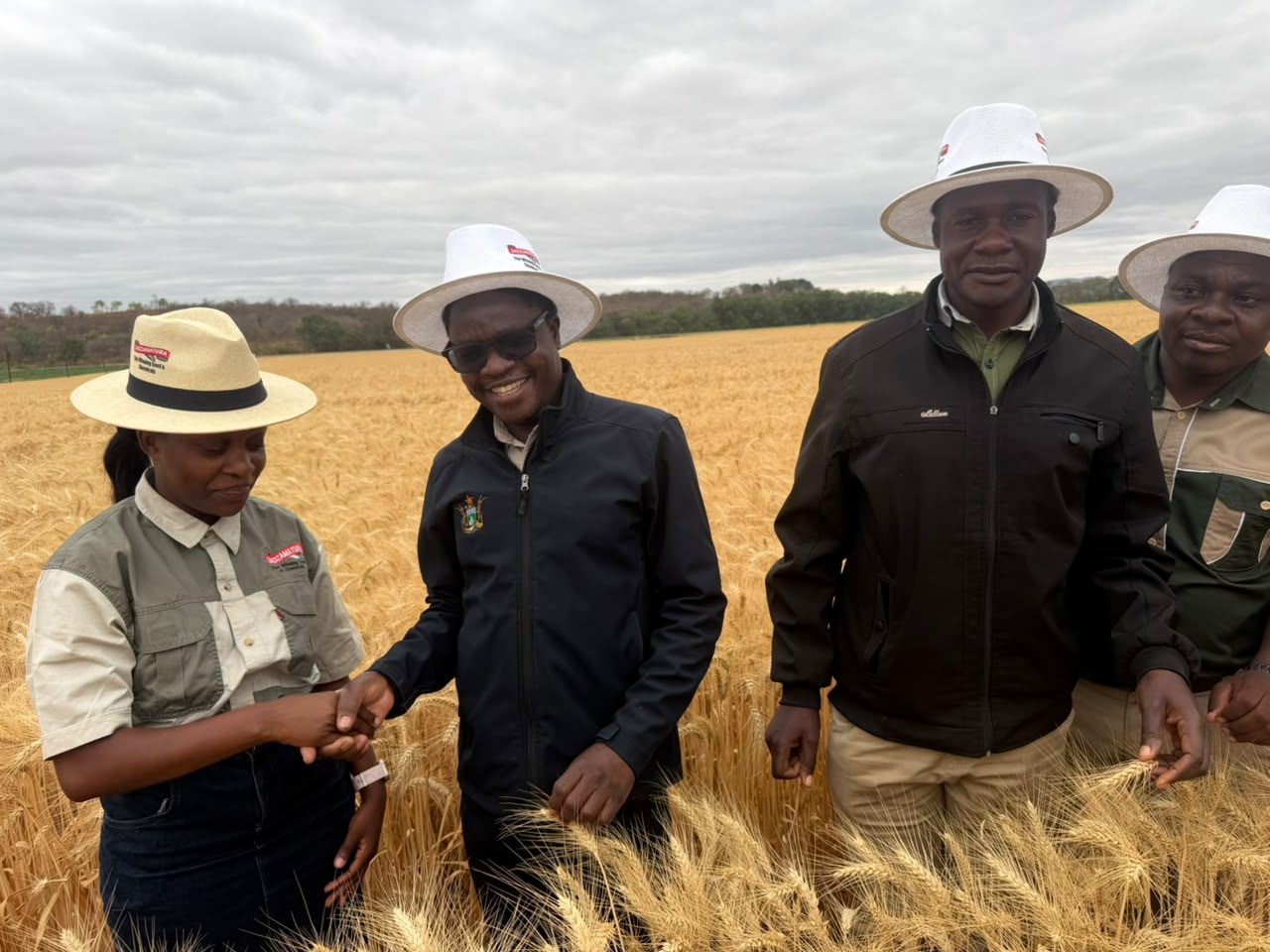
by Gideon Madzikatidze/Simbarashe Sithole
BINDURA – Mashonaland Central Province has surpassed its winter wheat target, planting 25,755 hectares against a target of 25,000 hectares, as Government pushes for wheat-based food security, a senior Agriculture official has said.
Provincial Director for Mashonaland Central in the Ministry of Agriculture, Mechanisation and Water Resources Development, Mr Misheck Chitokomere, made the disclosure during a field day organised by Zadzamatura at farmer Canaan Mutonda’s Pemento 24 Farm in Bindura District.
Chitokomere was speaking while standing in a golden, healthy wheat crop planted on the 1st of May, 2026, which he said falls within the proper planting window for wheat.
“This is Ward 11, Pemento Park farm. We are witnessing this crop which was planted on 1 May 2026, which is the proper planting window for the wheat crop. No wonder why you can see that it’s a very healthy crop where we are expecting yields of seven and above tonnes per hectare,” he said.
He commended farmers in the province for exceeding the target.
“As a province our target was 25,000 hectares, but we managed to surpass the target and we achieved 25,755 hectares as a province. So basically we are saying well done to our farmers,” Chitokomere said.
He said the bulk of the province’s wheat is grown in Mazowe and Bindura Districts, followed by Shamva and to a lesser extent Rushinga, Mount Darwin and Muzarabani.
“As a government we are going towards what we call a wheat-based food security. Once we meet our targets like that we are also in to meet our targets in terms of the yield,” he said.
Chitokomere revealed that harvesting has already started across the province.
“Harvesting has actually started. And as at now, 800 hectares of wheat has been harvested across the province and the average yield so far is 5.5 tonnes per hectare. Our target was five, so it means we are already above what we had targeted to achieve,” he said.
He projected the provincial average to close between 5 and 6 tonnes per hectare, which will translate to very good tonnage.
The Provincial Director however urged farmers to expedite harvesting, warning that early showers have been received in some areas.
“What we are actually recommending our farmers now to do is to expedite harvest because so far we have received showers in places like Concession, in places like Glendale. We want our farmers to expedite harvesting so that their produce is not affected by the rains,” he warned.
“So far some places have reported rainfall amounting to 33 millimetres, some 52 millimetres in other places. But fortunately for us the clouds yes they are threatening but I am sure that all those farmers who are ready should actually rush to their fields, harvest the crop before these rains. Otherwise the wheat crop will be affected,” Chitokomere added.
Meanwhile, Senior Agronomist at Zadzamatura, Mr Blessing Hatidane hailed farmers for heeding the government’s call and adopting good agronomic practices.
“We are proud as Zadzamatura to walk with farmers like Mr Mutonda. What you are seeing here is not by chance, it is a result of timely planting, correct variety selection and adherence to agronomic advice. Farmers have responded positively to the call for food security and we are urging them to also consider small grains and early maturity varieties as we prepare for an El Nino-induced season,” Hatidane said.
“We are here to ensure that knowledge reaches the field. Our mandate is to complement Government efforts by providing extension support, inputs advice and linking farmers to markets,” he added.
Host farmer, Mr Canaan Mutonda, who owns Pemento 24 Farm, said the field day was an affirmation of Government empowerment programmes.
“I am very grateful to Government and to Zadzamatura for the support. This crop you see is testimony that when a farmer is empowered with inputs and technical knowledge, we can produce and feed the nation. We will continue to complement Government’s food security efforts as local farmers,” Mutonda said.
He added that his target is to push yields beyond 7 tonnes per hectare through precision farming.